
Winged Victory of Brescia
Roman bronze statue discovered in 1826, symbol of Brescia.
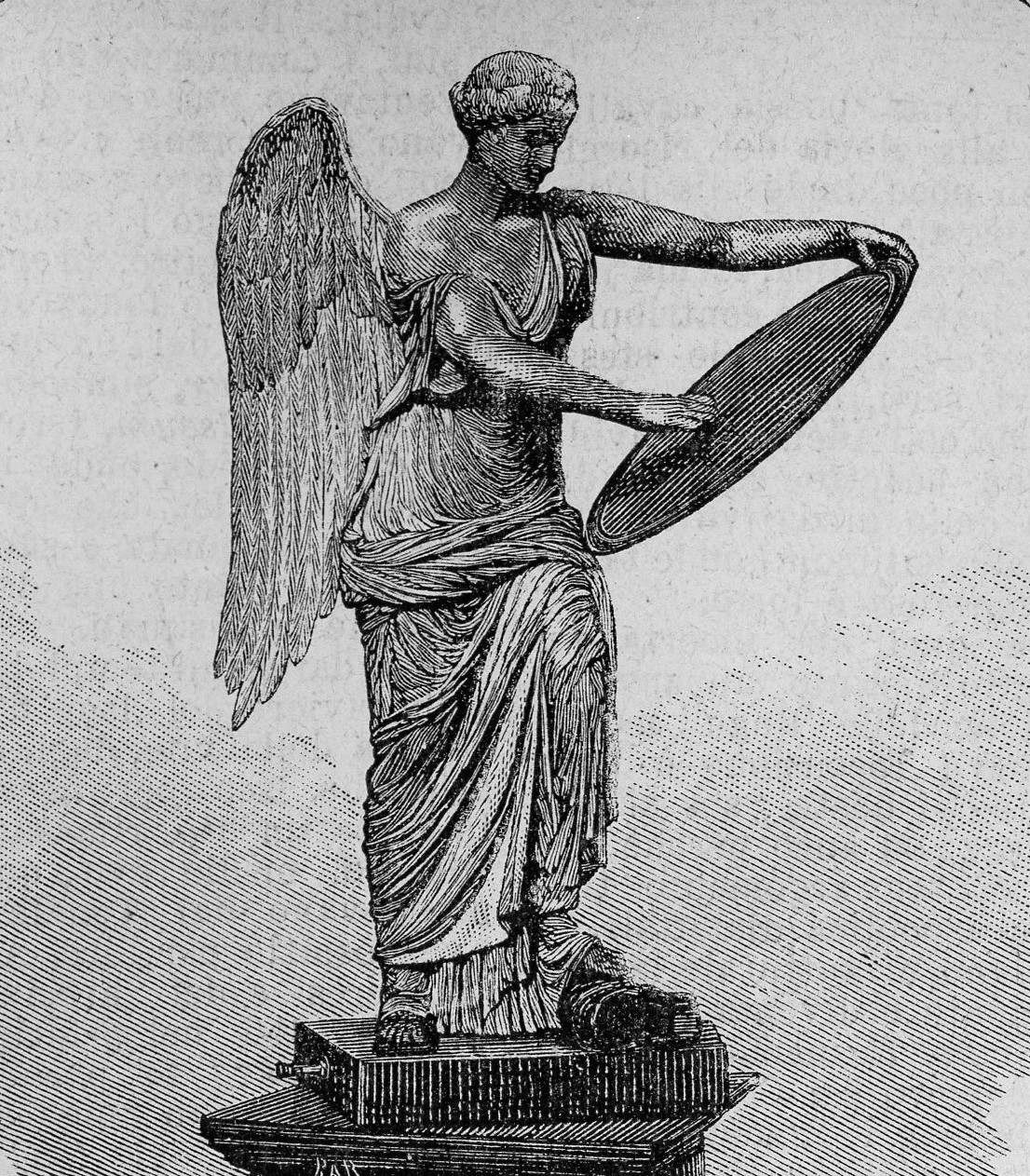
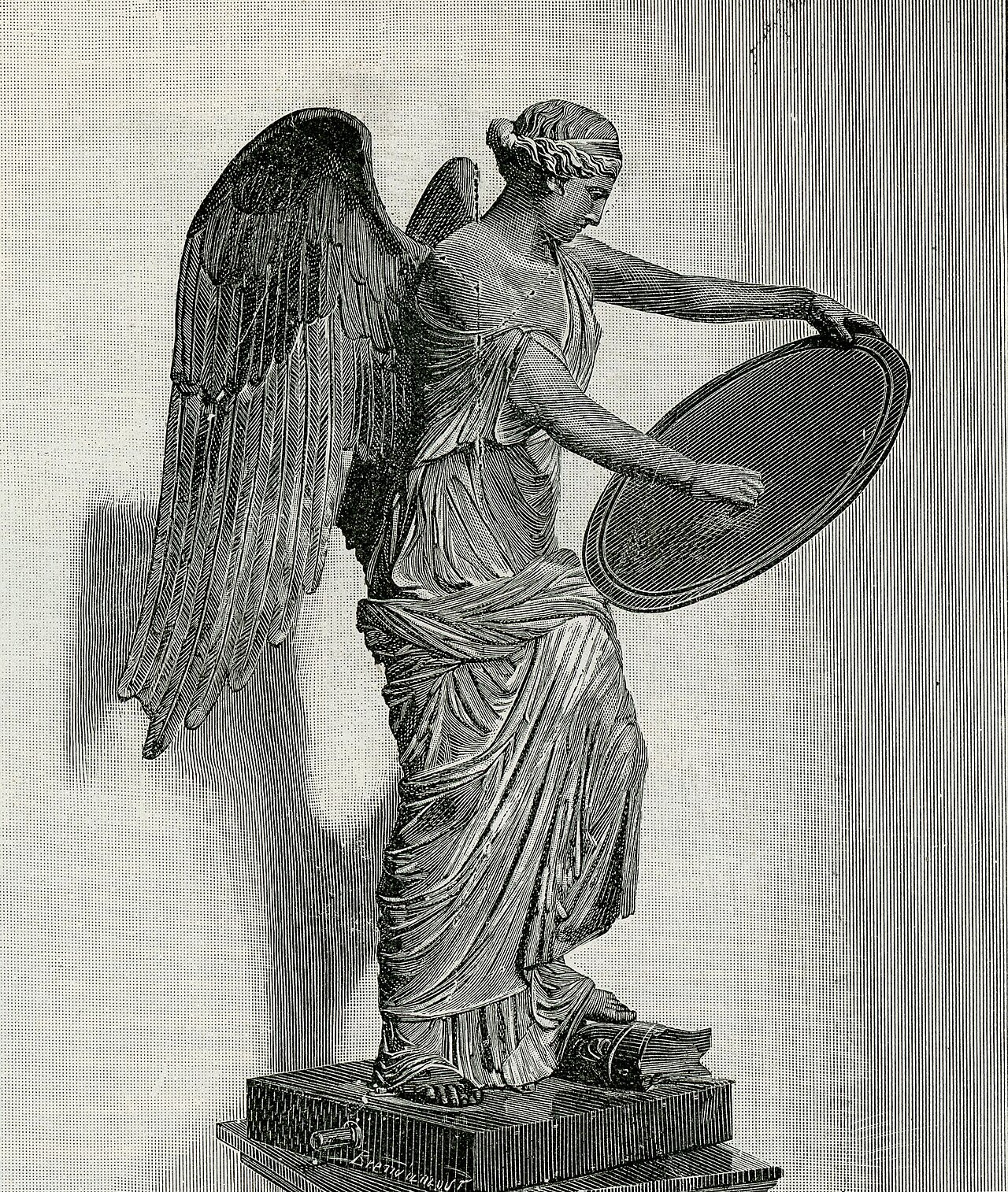
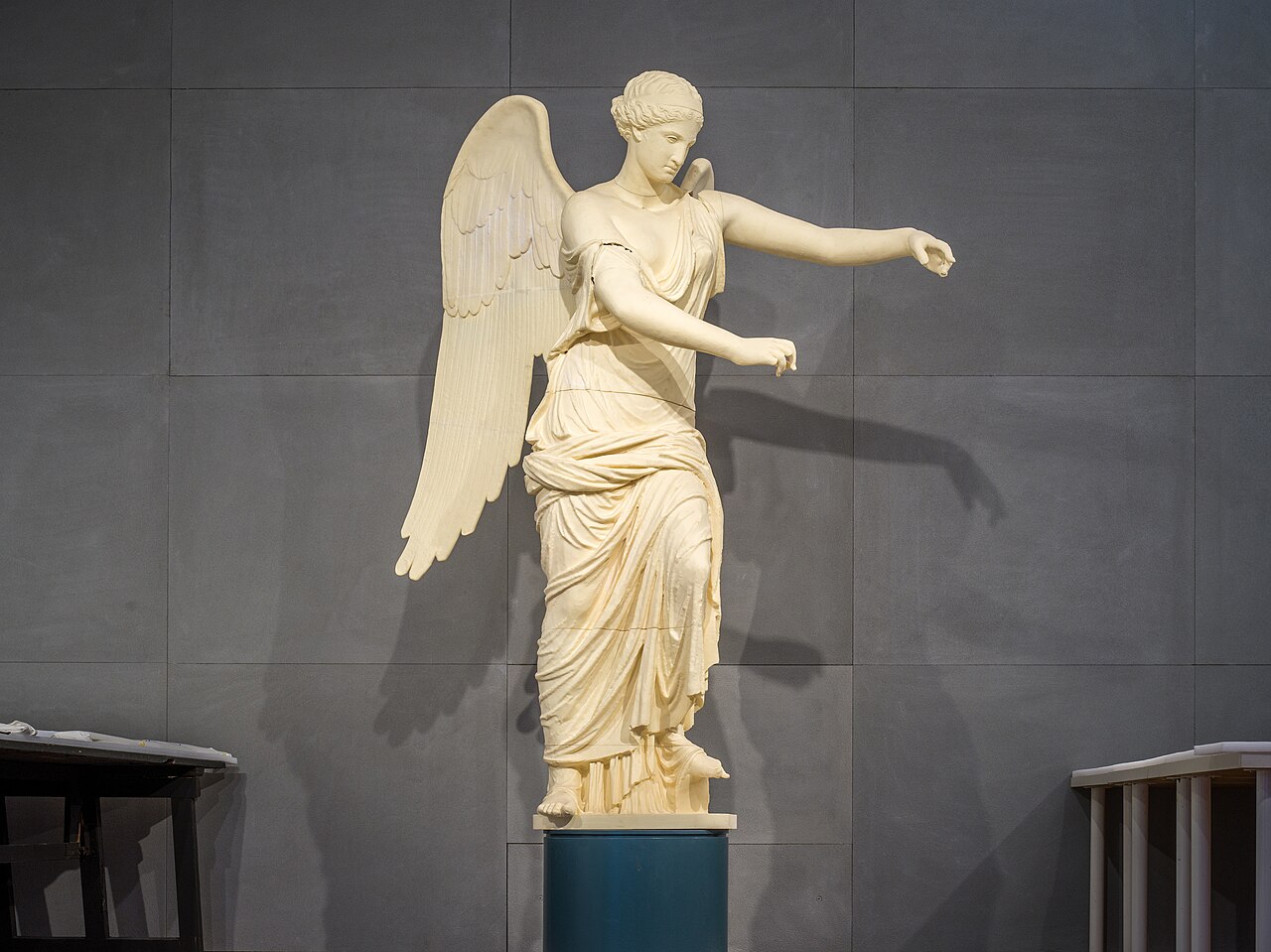
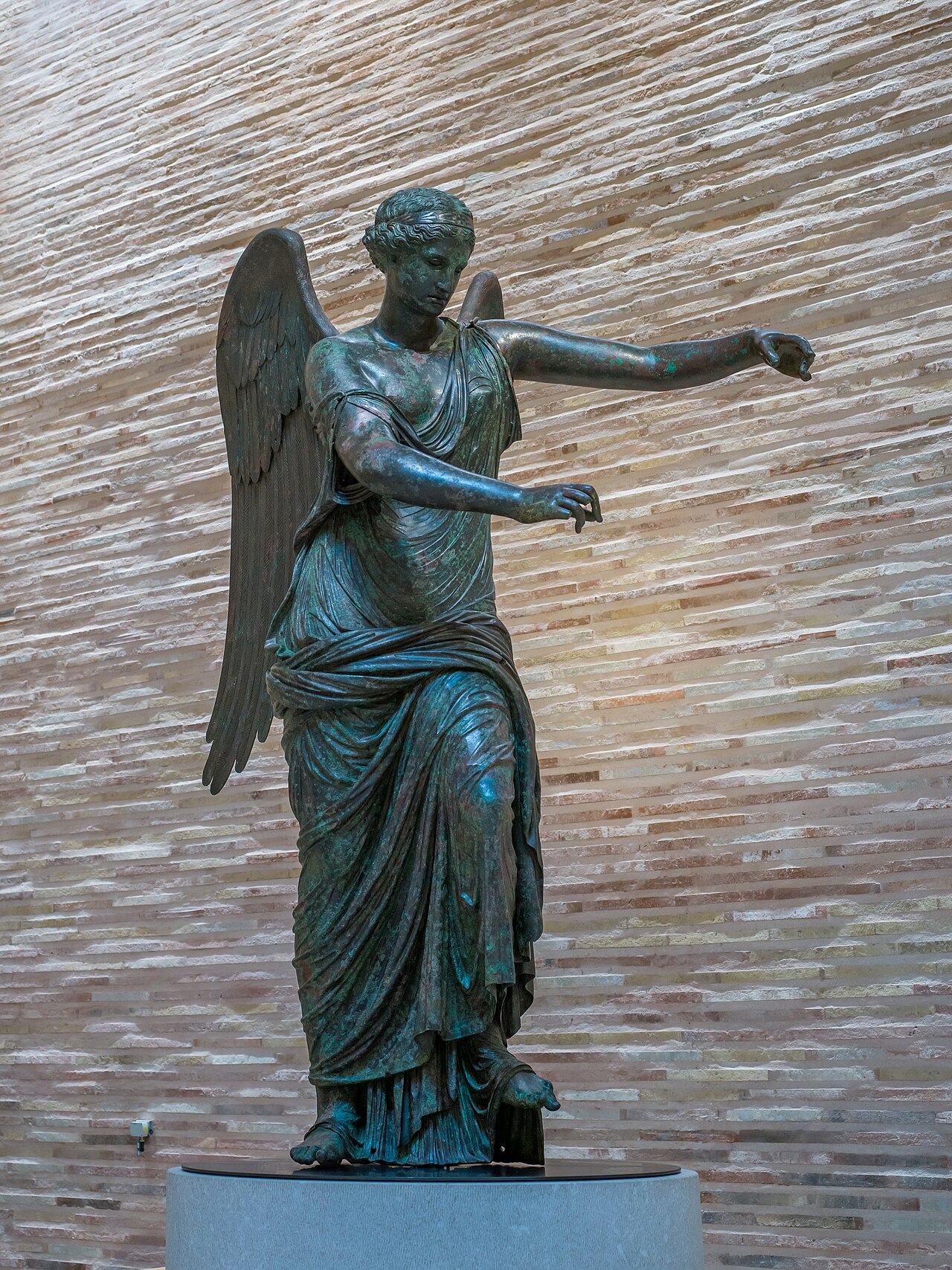
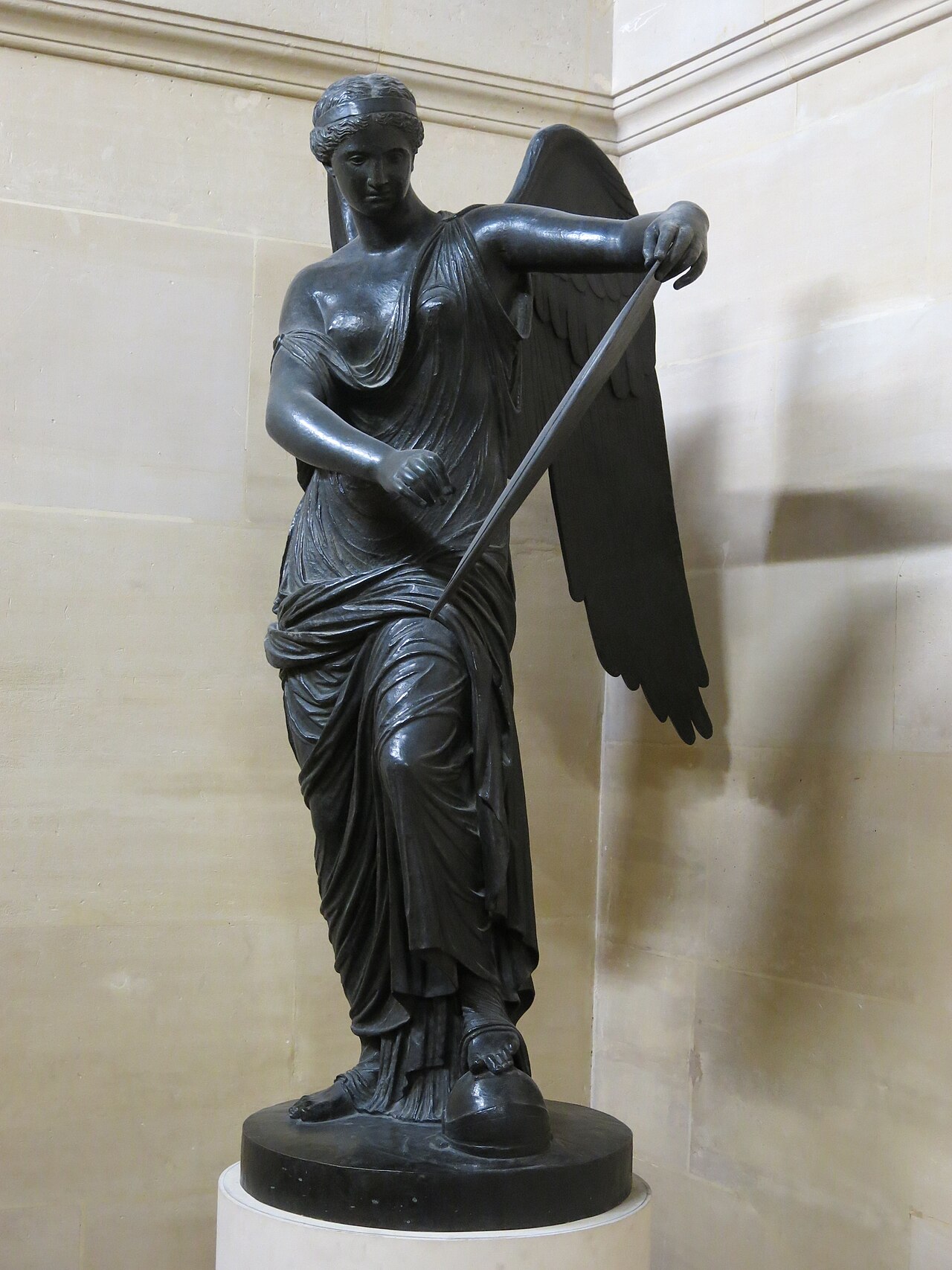
The Winged Victory of Brescia is a bronze statue dating to the 1st century AD, on display at the Capitolium of Brescia. It was uncovered there in 1826 alongside other Roman bronzes and is considered a key emblem of the city.
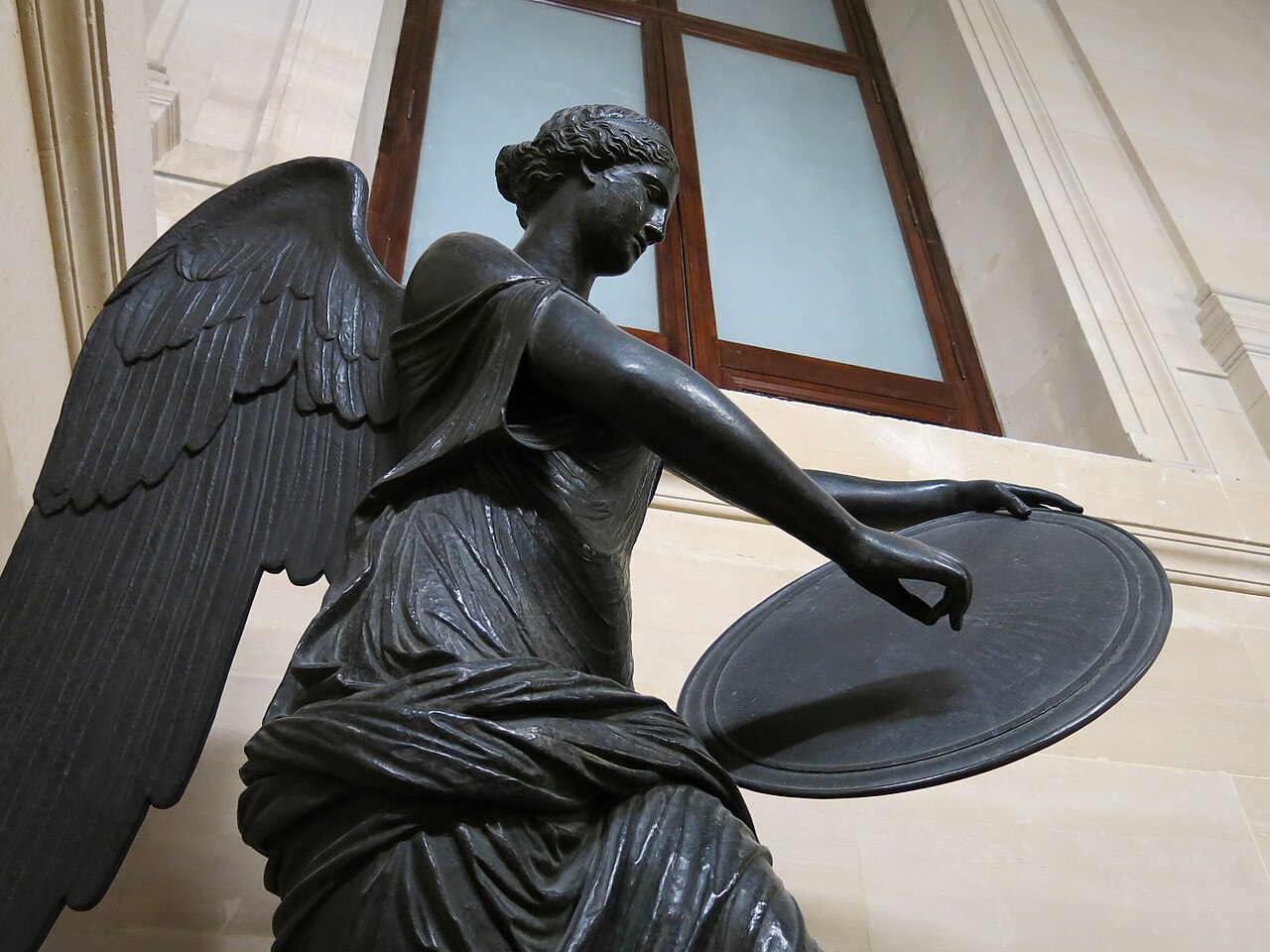
Early 19th-century scholars thought it was a Hellenistic work from around the mid-3rd century BC, later reworked in Roman times. However, further study revealed it to be a Roman pastiche, assembled after 69 AD from an earlier Hellenistic casting. A recent restoration by the Opificio delle Pietre Dure confirmed the statue was cast in the 1st century AD at a local foundry, not assembled from different statues, and was always intended as a "Winged Victory." Its model is the Aphrodite Urania of the "Cyrene type," with torso torsion and arm positioning borrowed from Greek works of the 5th–6th century BC. The figure wears a shoulder-fastened chiton and a himation wrapped around her lower limbs. Her left leg is slightly raised, likely resting on the helmet of Mars. Silver and copper damascening adorned her hair. Wings were added in Roman times to transform the figure into the goddess Victoria; similar works (Victory inscribing a shield) existed in the imperial forums of Rome and Constantinople.
After centuries of obscurity, the statue was discovered on the evening of July 20, 1826, partially disassembled and deliberately hidden in the western cavity of the Capitolium, between the temple and the Cidneo hill, along with other bronze pieces including portraits. This concealment likely aimed to prevent melting for weapons during barbarian invasions (Goths and Huns), explaining its excellent preservation.
During World War I, the Victory was moved to Rome by government order for safekeeping from the front. After the war, Senator Pompeo Gherardo Molmenti, Undersecretary for Antiquities and Fine Arts, oversaw its return to Brescia, which occurred with a formal celebration in April 1920. The statue was loaned to the Kunsthaus Zürich from November 1948 to March 1949 for the exhibition *Kunstschätze der Lombardei. 500 vor Christus, 1800 nach Christus*.
An early hypothesis suggested the statue was brought to Rome by Augustus after Cleopatra’s death in 29 BC, then donated to Brixia as a political gesture, perhaps when the city was granted the title Colonia Augusta. It was supposedly transformed into Nike after the Second Battle of Bedriacum, where Marcu
- Date
- 1st century AD
- Material
- Bronze
- Location
- Capitolium of Brescia
- Discovered
- 1826
- Type
- Statue
- Subject
- Winged Victory (Victoria)
Lore & Background
Initially believed to be a Hellenistic work from the mid-3rd century BC, later studies recognized it as a pastiche created in Roman times after 69 AD. A restoration by the Opificio delle Pietre Dure established that the statue was cast in the 1st century AD in a local foundry and was not an assemblage but created as a 'Winged Victory.' The reference model is the Afrodite Urania of the 'Cyrene type.' The figure wears a chiton and himation, with the left leg slightly raised, possibly resting on the helmet of Mars. In Roman times, wings were added to transform the work into the goddess Victoria.
The statue was discovered on July 20, 1826, partially disassembled and hidden in the western cavity of the Capitolium, likely to prevent melting during barbarian invasions. During World War I, it was moved to Rome for safekeeping and returned in April 1920 under Senator Pompeo Gherardo Molmenti. It was loaned to the Kunsthaus Zürich from November 1948 to March 1949. An early hypothesis suggested the statue was brought to Rome by Augustus after Cleopatra's death and donated to Brixia, later transformed into Nike after the Second Battle of Bedriacum. However, X-ray fluorescence analyses showed no significant differences between wings and body, indicating a single constructive process.
Reader's Guide
The Winged Victory of Brescia holds significance as a rare surviving Roman bronze and a civic symbol of Brescia. Its discovery in 1826, hidden to prevent destruction, underscores the value placed on such works during times of conflict. The statue's history reflects scholarly debates about its origins—whether a Hellenistic original, a Roman pastiche, or a single-cast creation—with modern scientific analysis supporting the latter. Its transformation from a possible Aphrodite to a Victory figure illustrates Roman adaptation of Greek models. The statue's travels for safekeeping during World War I and its return highlight its cultural importance. Numerous copies worldwide, from Paris to New York, attest to its enduring legacy as an artistic masterpiece. The 2018 restoration and new display structure further cement its role as a key artifact of Roman art and Brescian heritage.
Did You Know?
- The statue was discovered on July 20, 1826, partially disassembled and hidden in the Capitolium of Brescia.
- X-ray fluorescence analyses revealed no significant differences between the wings and the body, suggesting a single constructive process.
- A bronze reproduction of the statue was donated to Napoleon III after the Battle of Solferino in 1859.
- The statue was loaned to the Kunsthaus Zürich from November 1948 to March 1949.
A Hidden Treasure Reclaimed
On the evening of July 20, 1826, workers uncovered a remarkable bronze figure tucked away in the western cavity of the Capitolium of Brescia, wedged between the temple structure and the Cidneo. The statue was found partially disassembled and carefully concealed alongside a collection of other Roman bronzes, including a series of portrait busts. The explanation for this deliberate hiding is striking: during centuries of barbarian invasions by Goths and Huns, the city's inhabitants apparently sought to protect their most valuable metalwork from being melted down to forge weapons. This act of preservation, born of desperation, ultimately gifted future generations an object in exceptional condition. The discovery transformed the Winged Victory into one of Brescia's most recognizable emblems, a tangible link to the city's Roman past that had lain dormant for nearly two millennia. The statue's survival, intact and largely unaltered, made it a singular treasure among Roman bronzes, and its reappearance in the nineteenth century immediately placed it at the center of scholarly debate about its origins, date, and artistic lineage.
Debunking the Pastiche
For much of the nineteenth century, scholars assumed the Brescia Victory was a Hellenistic masterpiece from around the mid-third century BC, later patched together in Roman imperial times from pieces of different statues. This pastiche theory dominated for decades. That consensus began to crumble when the Opificio delle Pietre Dure, working alongside specialists from Sapienza University of Rome, undertook a comprehensive restoration beginning in July 2018. The interdisciplinary team of archaeologists, engineers, scientific consultants, and restorers concluded that the figure was not an assemblage at all but a single casting produced in a local foundry during the first century AD. Critical evidence came from X-ray fluorescence analyses conducted as part of a research project at the Institute of Archaeological Sciences of Goethe University Frankfurt, led by Edilberto Formigli and Andrea Salcuni. The scans revealed no significant compositional differences between the wings and the body, indicating the entire work was created in one constructive process. This finding fundamentally redefined the statue's identity: it was made to be a Winged Victory from the outset, not a repurposed Aphrodite.
From Aphrodite to Victoria
The statue's pose draws on a well-known Greek model: the Afrodite Urania of the Cyrene type, a specific variation of the goddess's posture identified in a sculpture found at Cyrene. Additional details—the subtle torsion of the torso, the particular arrangement of the arms—echo Greek works from the fifth and sixth centuries BC. The figure wears a chiton pinned at the shoulders and a himation draped around the lower limbs, while the left leg lifts slightly, suggesting the foot once rested on the helmet of Mars. The hair was adorned with silver and copper damascening on the head. A long-held hypothesis proposed that Augustus had the statue brought to Rome after Cleopatra's death in 29 BC, then gifted it to Brixia as a gesture of political goodwill, perhaps when the city received the title Colonia Augusta. The transformation from Aphrodite to Victory was then linked to the Second Battle of Bedriacum, where Marcus Antonius Primus defeated Vitellius, clearing Vespasian's path to the throne. Vespasian subsequently ordered a monumental renovation of the forum and Capitoline temple, and it was assumed the goddess received two large feathered wings on her back while her hands were repositioned to inscribe a dedicatory text on the shield of Ares, which has since been lost.
A City's Emblem Across Centuries
The Winged Victory's journey did not end with its 1826 rediscovery. When World War I threatened cultural treasures along the front lines, the Italian government ordered the statue transferred to Rome for safekeeping. After the war, Senator Pompeo Gherardo Molmenti, appointed Undersecretary for Antiquities and Fine Arts, personally oversaw its return to Brescia in a solemn ceremony in April 1920. The statue's fame continued to spread: from November 1948 to March 1949 it was loaned to the Kunsthaus Zürich for an exhibition celebrating Lombard art. Across Italy, the Victory became a symbol of remembrance and civic pride, spawning numerous reproductions—a gilded bronze atop a war memorial column in Bolsena, a 1919 cast by Paolo Enrico De Barbieri in Carcare, a wingless copy commissioned by Gabriele D'Annunzio for the Vittoriale in Gardone Riviera, and replicas in Rovereto, Trento, and Passo del Tonale. In Brescia itself, copies grace Palazzo della Loggia, a 1935 bronze in the Cloister of Memory, and a Rotary Club donation at a Via Labirinto roundabout. Today, the original stands in a purpose-built structure designed by Spanish architect Juan Navarro Baldeweg, set on a new earthquake-resistant base at the Capitolium.
Gallery
Frequently Asked Questions
What is the Winged Victory of Brescia?
It is a 1st-century AD bronze statue of the goddess Victoria, housed at the Capitolium of Brescia. Unearthed in 1826, it has since become one of the city's most recognizable symbols.
Where can I see the Winged Victory of Brescia?
The statue is on display at the Capitolium of Brescia in northern Italy. It was found on that very site in 1826, alongside a collection of other Roman bronze pieces.
When was the Winged Victory of Brescia actually made?
A restoration by the Opificio delle Pietre Dure confirmed it was cast in the 1st century AD at a local foundry. Earlier 19th-century scholars had wrongly dated it to the mid-3rd century BC.
What is the Winged Victory of Brescia made of?
The statue is cast in bronze and was assembled after 69 AD from an earlier Hellenistic casting. This makes it a Roman pastiche rather than a single original work.
Why is the Winged Victory of Brescia significant to the city?
It is regarded as a key emblem of Brescia and a major source of local identity. Its 1826 discovery helped cement the Capitolium site as an important Roman archaeological location.
More in Ancient Rome 1-24
Spotted an error? Know more?
This is a living reference — every entry is fact-audited, and reader corrections feed straight into our audit queue. Suggest an edit · See this site's audit record